Choosing the right boat davit system starts with understanding your dinghy, the vessel it will be mounted on, and how you prefer to launch and retrieve your tender. A suitable davit should support the fully loaded tender within its approved limits, fit the available mounting area, and provide an operating method that works for your boating needs.
At SeaWise Marine, we offer manual and electric davit systems designed for compatible dinghies, inflatable tenders, and rigid inflatable boats (RIBs). Both systems are designed to maintain outboard motor orientation during compatible tender handling.
This guide explains the main factors to consider, how to compare available davit types, and when to request a vessel-specific fit assessment.
What Should You Consider When Choosing a Boat Davit?
The right boat davit is not necessarily the system with the highest advertised lifting capacity.
Five important factors influence selection:
- Fully loaded tender weight: The complete weight of the dinghy, outboard, fuel, and equipment.
- Main vessel compatibility: The strength and suitability of the intended mounting structure.
- Tender dimensions: Available clearance around the transom or swim platform.
- Operating method: Whether manual hand-crank or powered lifting better suits your needs.
- Installation requirements: The approved mounting, electrical, and maintenance requirements for the system.
These factors should be considered together before selecting a davit.
Understand Your Fully Loaded Tender Weight
One of the most common mistakes when choosing a davit is relying on the dinghy’s advertised dry weight. Dry weight may exclude components and equipment that remain aboard when the tender is lifted.
What Counts Toward the Total Weight?
Depending on the tender, the suspended load may include the hull, outboard motor, fuel, battery, steering equipment, installed accessories, and other gear.
For example, consider this hypothetical tender:
| Component | Example weight |
|---|---|
| Dinghy hull | 250 lbs |
| Outboard motor | 110 lbs |
| Fuel and battery | 45 lbs |
| Additional equipment | 20 lbs |
| Total | 425 lbs |
In this example, the loaded tender weighs 425 lbs, even though the hull alone weighs only 250 lbs.
These numbers illustrate the importance of accounting for equipment. They are not measurements for a particular dinghy.
Should You Add a Safety Margin?
Do not apply an arbitrary percentage and assume it establishes safe lifting capacity. The correct loading requirements, allowances, and limitations must come from the davit manufacturer’s approved specifications and any relevant engineering assessment.
If your tender weight is unknown, confirm the component weights before choosing a system. For more detailed measurement and sizing guidance, read How to Determine the Right Boat Davit Size.

Compare Manual and Electric Boat Davit Systems
SeaWise offers two main davit configurations: manual and electric. The manual system uses a geared hand-crank mechanism, while the electric system uses switch-operated lifting.
The appropriate choice depends on the tender weight, vessel configuration, and operating preferences.
Manual Davit Systems
The SeaWise Manual Davit System is designed for compatible dinghies and tenders weighing up to the published capacity of 450 lbs (204 kg).
Its geared hand-crank mechanism allows lifting without electrical lifting power. A manual system may be worth considering if your tender is within its approved capacity, you prefer mechanical operation, and your vessel meets the installation requirements.
Hand-crank operation still requires appropriate conditions, suitable physical capability, equipment maintenance, and adherence to the approved instructions.
Electric Davit Systems
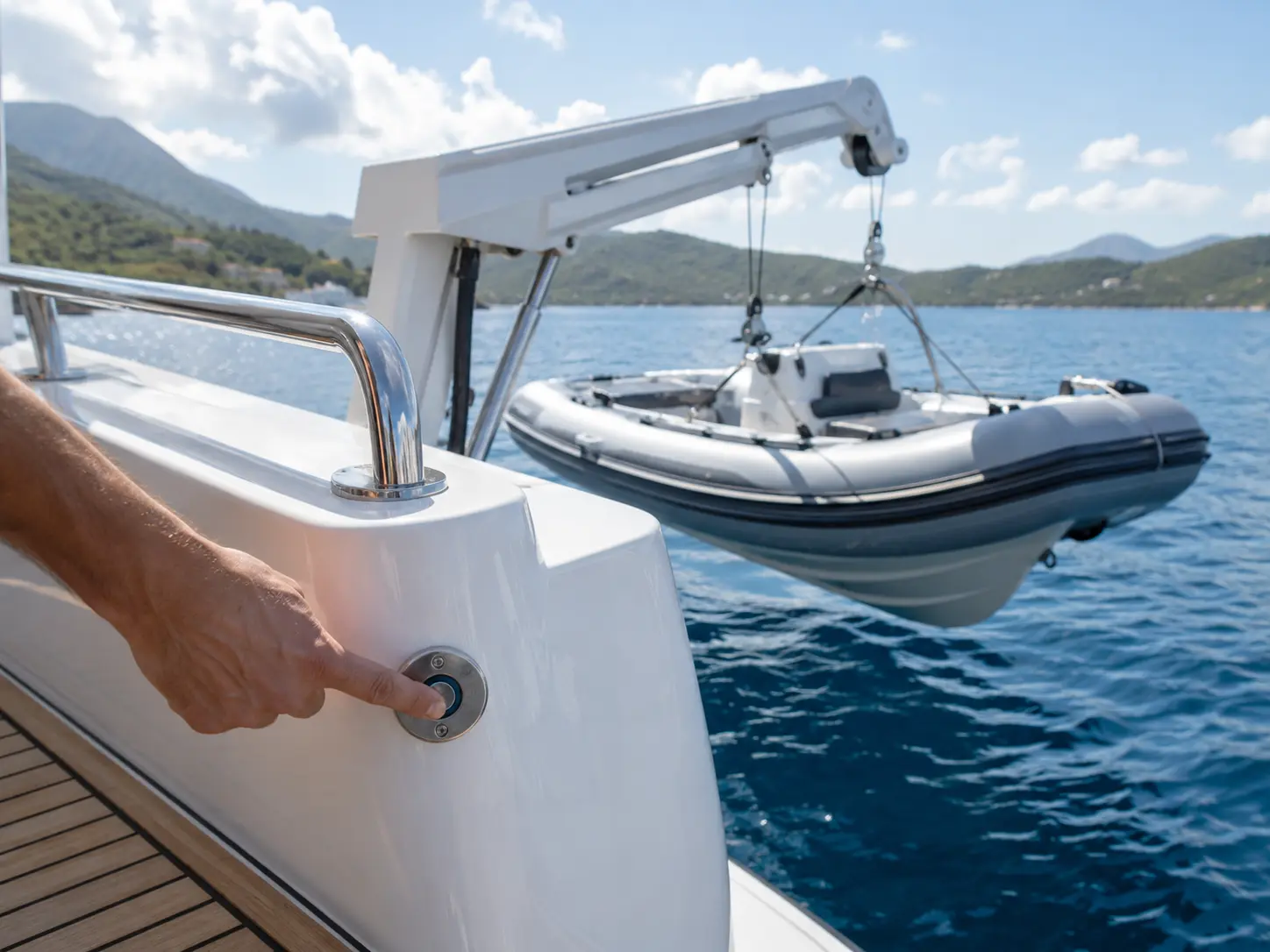
The SeaWise Electric Davit System provides switch-operated lifting for compatible tenders. Its supplied product specifications list a lifting capacity of up to 650 lbs (295 kg).
Powered operation may suit boaters who prefer an alternative to manual cranking or whose compatible tender exceeds the manual system’s published capacity.
The electric system also includes an emergency-release feature described in the supplied product brochure. Its procedures and limitations must be confirmed for the specific installation.
Manual vs Electric: Quick Comparison
| Feature | Manual Davit | Electric Davit |
|---|---|---|
| Published lifting capacity | Up to 450 lbs (204 kg) | Up to 650 lbs (295 kg) |
| Lifting method | Geared hand crank | Switch-operated |
| Electrical lifting power | Not required | Required |
| Outboard orientation | Automatically maintained | Automatically maintained |
| Construction | Electropolished 316L stainless steel | Electropolished 316L stainless steel |
| Warranty | Five-year limited | Five-year limited |
For a more detailed comparison of operational differences and ownership considerations, see Electric vs. Manual Boat Davits.
Check Your Boat’s Mounting Structure
Even when a tender is within the advertised lifting capacity, the main vessel must be suitable for the proposed installation.
Davit mounting requirements depend on the vessel’s design and the approved configuration.
Swim Platform Construction
Swim platforms can differ in materials, dimensions, structural support, and attachment methods.
A platform should not be assumed capable of supporting a davit installation simply because it provides enough visible space.
Transom and Mounting Geometry
The davit must fit the intended mounting area while accommodating the tender’s movement and stored position. Incorrect mounting geometry or inadequate support may affect operation and load transfer.
Structural Assessment
Some installations may require qualified inspection, engineering review, or professional installation. SeaWise should review the main vessel and proposed configuration before confirming suitability.
For additional installation guidance, see Can I Install a SeaWise Davit Myself?.
Consider Tender Size and Storage Clearance
Tender weight is only one part of selecting an appropriate davit. The dinghy’s length, beam, hull shape, and outboard position also influence the available storage arrangements.
Before choosing a system, consider whether the tender can move through its approved lifting and lowering range without contacting the vessel or other equipment.
Swim Platform Clearance
A compatible davit installation may help organize tender storage near the stern. However, the amount of usable swim-platform space depends on the boat, tender, and mounting configuration.
Do not assume that every installation will leave the platform completely unobstructed. Explore our guide to dinghy davits for swim platforms for more information.
Outboard Motor Position
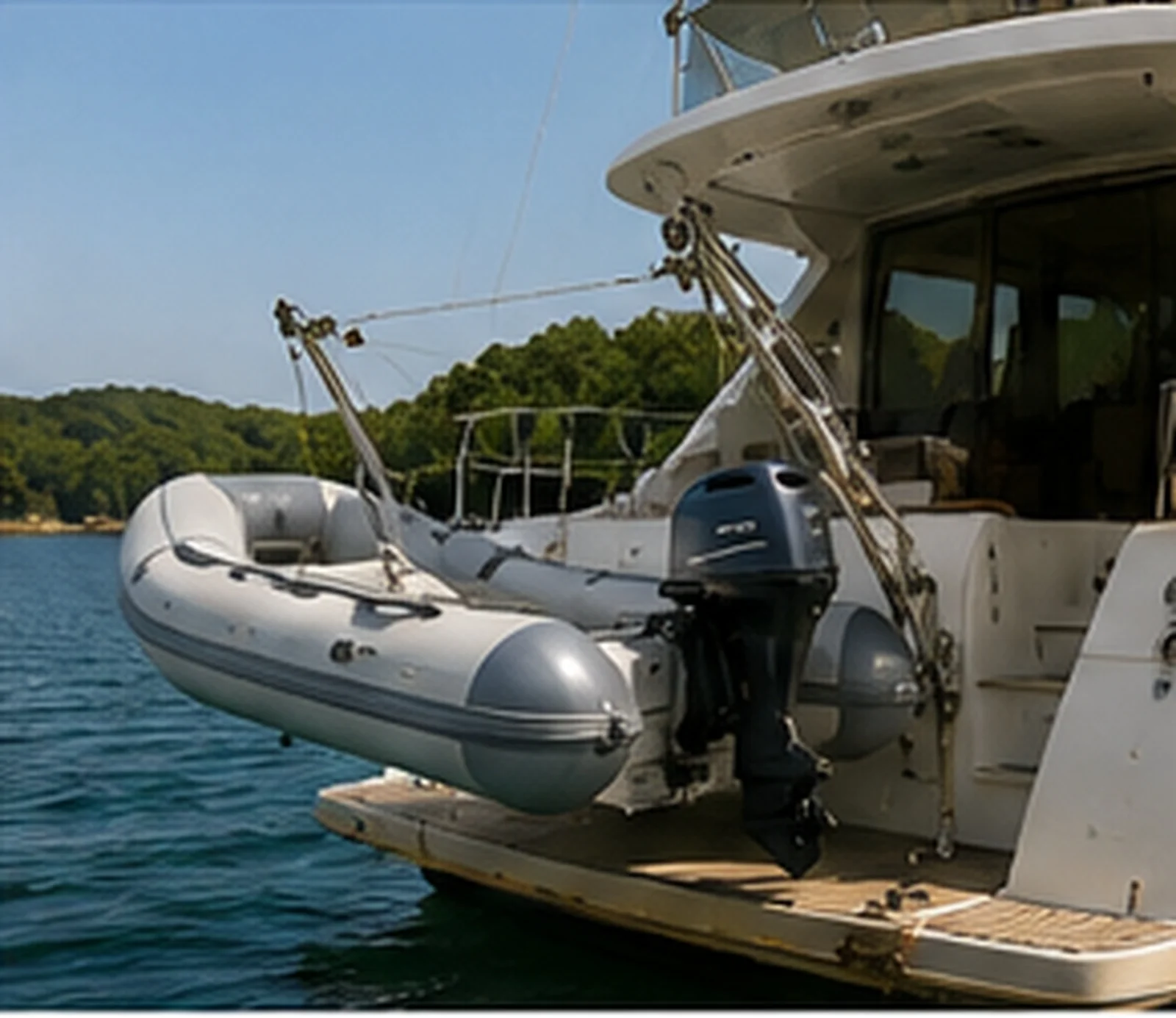
SeaWise davits are designed to maintain the outboard motor’s orientation during compatible tender handling. This may reduce the need to repeatedly remove the motor during normal launching and storage.
Motor-on compatibility must still be confirmed using the complete loaded tender weight, available clearance, and approved installation.
Learn more about storing a dinghy with the outboard attached.
Match Your Davit to Your Boating Style
Consider how and where you use your dinghy.
Frequent Tender Use
If you regularly launch and retrieve your dinghy, switch-operated lifting may be a convenient option.
Manual operation may also be appropriate when the tender and installation meet the system requirements.
Longer Cruising Trips
Some owners prefer manual lifting because the mechanism does not require electrical power.
Others prefer electric lifting for routine use. Neither system should be described as universally reliable under every circumstance. Proper maintenance and approved operating procedures remain essential.
Heavier RIB Tenders
RIB tenders with larger motors, consoles, fuel, and additional equipment may exceed the capacity of a smaller lifting system.
The electric system’s higher published capacity may make it suitable for certain heavier RIBs, subject to compatibility confirmation.
For more specific guidance, see Best Dinghy Davits for Heavy RIB Tenders.
What About Installation, Maintenance and Long-Term Ownership?
The total ownership experience involves more than purchasing the davit itself. Installation requirements, ongoing inspections, electrical considerations, service access, and replacement components may influence which system is appropriate.
Installation Planning
Confirm whether the proposed installation requires professional mounting work, electrical integration, or a vessel-specific structural assessment.
Do not assume that instructions for one boat or davit model apply to every installation.
Marine-Grade Materials
SeaWise’s supplied product information identifies electropolished 316L stainless steel components in both davit systems.
This material provides corrosion resistance in marine environments, but it is not immune to damage or deterioration.
Maintenance Requirements
Both manual and electric systems require inspections and maintenance according to their approved instructions. Watch for unusual operating resistance, visible damage, unexpected noise, and changes in lifting behaviour.
Stop using equipment that appears damaged or operates abnormally until the issue has been appropriately assessed. Read the Boat Davit System Maintenance Guide for general ownership considerations.

Boat Davit Selection Checklist
Before contacting SeaWise, gather the details needed for a useful compatibility review.
| Information | Why It Matters |
|---|---|
| Main vessel make, model and year | Helps identify the mounting arrangement |
| Dinghy make and model | Helps establish tender dimensions |
| Fully loaded tender weight | Determines whether published capacities may be suitable |
| Outboard model and weight | Contributes to total lifting load and clearance |
| Swim-platform or transom dimensions | Helps assess mounting space |
| Preferred lifting method | Helps compare manual and electric options |
| Operating location | Supports shipping and environmental considerations |
| Installation photographs | Helps clarify the current vessel arrangement |
Providing these details can reduce uncertainty during the selection process.
Common Mistakes When Choosing a Boat Davit
Selecting by Hull Weight Alone
A tender’s dry weight may not include the outboard motor, fuel, battery, and installed equipment. Always assess the complete load.
Assuming Higher Capacity Guarantees Compatibility
A davit rated above the tender’s weight may still be unsuitable if the mounting structure, clearances, or approved configuration do not meet the manufacturer’s requirements.
Ignoring Storage Clearance
Check the tender’s stored position and lifting path, not only the available space when the platform is empty.
Choosing Based Only on Price
Cost is important, but suitability and approved operating requirements should come first. For more buying considerations, read How Much Do Dinghy Davits Cost?.
Assuming Maintenance Is Unnecessary
Even corrosion-resistant equipment requires care. Follow the approved inspection and maintenance procedures for your installed model.
Frequently Asked Questions
How do I choose the right davit for my boat?
Start with the fully loaded tender weight, main vessel mounting structure, available clearance, and preferred lifting method. Confirm the approved system configuration with the manufacturer before buying.
What lifting capacity does the SeaWise manual davit offer?
The supplied product specifications list up to 450 lbs (204 kg), subject to model-specific and installation requirements.
What lifting capacity does the SeaWise electric davit offer?
The supplied product specifications list up to 650 lbs (295 kg), subject to the approved configuration and operating requirements.
Is an electric davit better than a manual davit?
Not necessarily. Electric davits provide powered lifting, while manual davits use a geared hand crank. The appropriate option depends on your tender, vessel, and operating preferences.
Can I keep the outboard attached to my dinghy?
SeaWise davits are designed to maintain outboard orientation during compatible operations. Confirm loaded weight, clearances, and approved installation requirements.
Will a SeaWise davit fit any boat?
No universal fit should be assumed. Compatibility depends on the main vessel, tender dimensions, mounting structure, and selected system.
Can I install a davit myself?
Owner installation may be suitable in some cases, but other applications may require professional installation or structural assessment. Follow the approved manufacturer instructions.
What if my tender is heavier than 650 lbs?
Do not exceed the approved lifting capacity of the proposed system. Contact SeaWise to discuss whether another approved configuration or alternative solution is appropriate.
Get Help Choosing the Right SeaWise Davit System
Choosing a boat davit involves matching the tender, main vessel, and lifting system—not simply selecting the highest capacity.
SeaWise Marine can review your vessel details and help determine whether a manual or electric configuration may be appropriate.
You can explore the SeaWise manual and electric davit systems and review examples in the SeaWise installation gallery.
Phone: 604-946-0551
Email: derek@seawisemarine.com